• 99%+ purity, third-party tested
  • Malaysia-based supplier, fast local delivery
  • Pay by Touch 'n Go QR, confirm on WhatsApp
  • For research use only
  • 99%+ purity, third-party tested
  • Malaysia-based supplier, fast local delivery
  • Pay by Touch 'n Go QR, confirm on WhatsApp
  • For research use only

All products are for laboratory research use only. Not for human consumption.

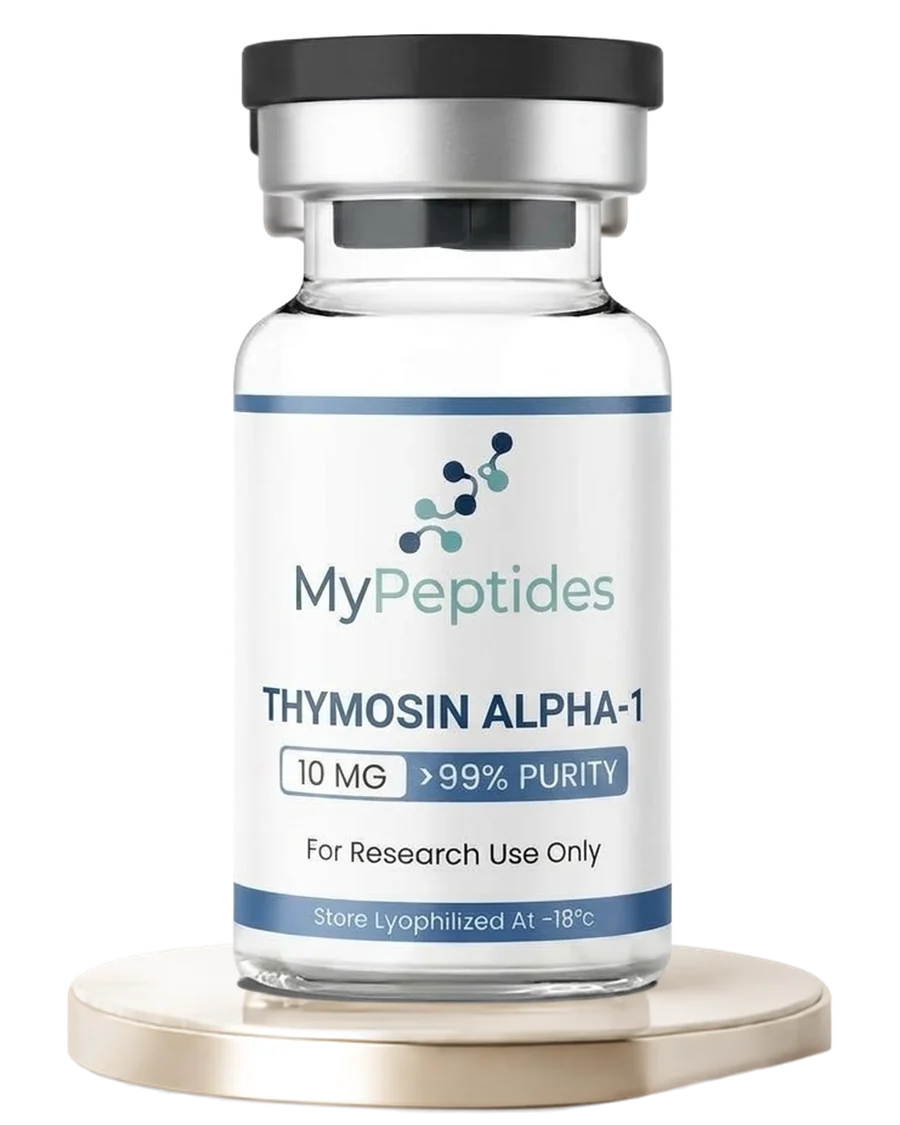
Thymosin Alpha-1 10 mg research peptide vial, >99% purity

Immune · Immune Defense

The Immune Shield

Thymosin Alpha-1

  • 10 mg
  • >99% purity
  • Lyophilised

RM 350

Fortify your sovereign shield. Thymosin Alpha-1 10 mg balances your body’s natural immune intelligence from the cell up.

Key mechanisms & benefits

  • It trains cellular defenses to navigate daily stressors, keeping your energy vibrant and uninterrupted.
  • Stay fiercely protected during travel or high-stress seasons, moving through your world with absolute confidence.
  • By gently modulating immune responses, it prevents system fatigue and ensures pure, steady vitality.
Certificate of Analysis

All products are independently tested by accredited third-party laboratories. Results confirm identity, purity, and potency.

In stock

1
  • No online payment. We confirm your order on WhatsApp.
  • Store lyophilised at −18 °C.
Ask about this product

For research use only. Not for human or veterinary consumption. This product is not a medicine and is not intended to diagnose, treat, cure or prevent any disease.

Overview

A Thymic Immune Peptide With Decades of Clinical Research

Thymosin alpha-1 (Tα1) is a 28-amino-acid, N-acetylated peptide that occurs naturally in the thymus and is known for modifying, enhancing and restoring immune function. A synthetic form is used clinically in several countries outside the US, including for hepatitis B and as an immune enhancer.

Tα1 has been studied in immunocompromised states, cancers, vaccine response, hepatitis B and sepsis. The sepsis evidence is mixed: a 2013 trial suggested lower mortality, but a larger, double-blind phase 3 trial of 1,089 patients published in 2025 found no reduction in 28-day mortality.

Mechanism of action

Immune Restoration

T-Cell and Immune Function

Enhances and restores immune responses

  • Naturally produced in the thymus
  • Long recognised for enhancing and restoring immune function
  • Used in immunocompromised states and as a vaccine enhancer
  • Studied for antiviral and antibacterial properties
  • Dominari A et al., World J Virol, 2020
Monocyte Function

Immune Markers in Sepsis

Improved monocyte HLA-DR in severe sepsis

  • Monocyte HLA-DR is a marker of immune competence
  • Greater mHLA-DR improvement than controls at days 3 and 7
  • Studied in 361 patients with severe sepsis
  • No serious drug-related adverse events
  • Wu J et al., Crit Care, 2013
Antiviral

Hepatitis B Research

Delayed but cumulative responses in chronic hepatitis B

  • Compared with interferon alpha in four randomised trials (199 patients)
  • Not clearly better at the end of 6 months of treatment
  • Responses increased after treatment ended
  • Better virological and biochemical response at 6-month follow-up
  • Yang YF et al., Antiviral Res, 2008

Key finding In the largest trial to date, a double-blind phase 3 study of 1,089 adults with sepsis, thymosin alpha-1 did not reduce 28-day all-cause mortality (23.4% vs 24.1% with placebo), and no secondary or safety outcome differed significantly from placebo.

Key research findings

1,089

Phase 3 sepsis trial: 28-day mortality 23.4% with Tα1 vs 24.1% with placebo, no significant difference

Wu J et al. BMJ, 2025
26% vs 35%

Earlier single-blind trial in severe sepsis: lower 28-day mortality with marginal significance and better mHLA-DR

Wu J et al. Crit Care, 2013
Hepatitis B

Compared with interferon alpha, responses were not better at end of treatment but were higher 6 months after

Yang YF et al. Antiviral Res, 2008
Thymus

Naturally occurring thymic peptide used for immunocompromised states and as a vaccine enhancer

Dominari A et al. World J Virol, 2020

Research areas

Immunology Research

How Tα1 enhances and restores immune function.

  • T-cell function
  • Monocyte HLA-DR
  • Immunocompromised models
  • Vaccine response

Infectious Disease Research

Hepatitis B, sepsis and other infections.

  • Chronic hepatitis B
  • Sepsis trials
  • Antiviral activity
  • Antibacterial properties

Oncology Research

Tα1 has been studied as an immune adjunct in cancer.

  • Immune adjunct studies
  • Immune reconstitution
  • Tumour immunology
  • Combination designs

Critical Care Research

Two large Chinese sepsis trials with conflicting results.

  • Severe sepsis
  • 28-day mortality
  • Subgroup analyses
  • Immune monitoring

Safety profile

Tα1 has been studied in more than 1,400 patients in the two sepsis trials alone, and in the large 2025 sepsis trial no safety outcome differed from placebo. It is used clinically in several countries but is not FDA-approved. Supplied here for laboratory research only.

  • Low
    Immune activation

    Enhances immune responses; account for this in autoimmunity and transplant research

  • Caution
    Mixed efficacy data

    The largest sepsis trial found no mortality benefit

  • Low
    Endogenous

    Naturally occurring thymic peptide

Human data
Extensive clinical research
Sepsis
No mortality benefit in phase 3
Endogenous
Thymic peptide

Theoretical contraindications in research models

  • Organ transplant research: immune activation
  • Autoimmune disease models: immune enhancement
  • Any human or veterinary use: research compound only

Molecular profile

Thymosin Alpha-1 Structure

Full name
Thymosin alpha-1 (Tα1)
Sequence
Ac-SDAAVDTSSEITTKDLKEKKEVVEEAEN
Amino acids
28
Molecular weight
≈ 3,108 Da
CAS number
62304-98-7
N-terminus
Acetylated

Clinical Status

Brand name
Zadaxin
Clinical use
Several countries outside the US
Uses studied
Hepatitis B, immune enhancement, sepsis, cancer
FDA status
Not approved

MYpeptides specification

Strength
10 mg
Purity
> 99%
Form
Lyophilised powder
Storage
Store lyophilised at −18 °C
Status
For research use only

Frequently asked questions

What is thymosin alpha-1?

Thymosin alpha-1 is a 28-amino-acid peptide that occurs naturally in the thymus. It is known for enhancing and restoring immune function, and a synthetic form is used clinically in several countries outside the US.

Does thymosin alpha-1 improve survival in sepsis?

The evidence is mixed. A 2013 trial of 361 patients found lower 28-day mortality (26% vs 35%) with marginal significance. But a larger, double-blind phase 3 trial of 1,089 patients published in 2025 found no difference (23.4% vs 24.1%).

What about hepatitis B?

A meta-analysis of four trials comparing Tα1 with interferon alpha found it was not better at the end of six months of treatment, but responses kept increasing after treatment ended and were higher at six-month follow-up.

How should thymosin alpha-1 be stored?

Lyophilised vials should be stored frozen at −18 °C or below, away from light. Once reconstituted for laboratory use, keep refrigerated at 2–8 °C.

References

  1. The efficacy and safety of thymosin α1 for sepsis (TESTS): multicentre, double blinded, randomised, placebo controlled, phase 3 trialWu J et al. BMJ, 2025 · PMID: 39814420
  2. The efficacy of thymosin alpha 1 for severe sepsis (ETASS): a multicenter, single-blind, randomized and controlled trialWu J et al. Crit Care, 2013 · PMID: 23327199
  3. Comparison of the efficacy of thymosin alpha-1 and interferon alpha in the treatment of chronic hepatitis B: a meta-analysisYang YF et al. Antiviral Res, 2008 · PMID: 18078676
  4. Thymosin alpha 1: A comprehensive review of the literatureDominari A et al. World J Virol, 2020 · PMID: 33362999
KPV 10 mg research peptide vialImmune

The Anti-Inflammatory Specialist

KPV

10 mg · >99% purity

In stock

RM 250