• 99%+ purity, third-party tested
  • Malaysia-based supplier, fast local delivery
  • Pay by Touch 'n Go QR, confirm on WhatsApp
  • For research use only
  • 99%+ purity, third-party tested
  • Malaysia-based supplier, fast local delivery
  • Pay by Touch 'n Go QR, confirm on WhatsApp
  • For research use only

All products are for laboratory research use only. Not for human consumption.

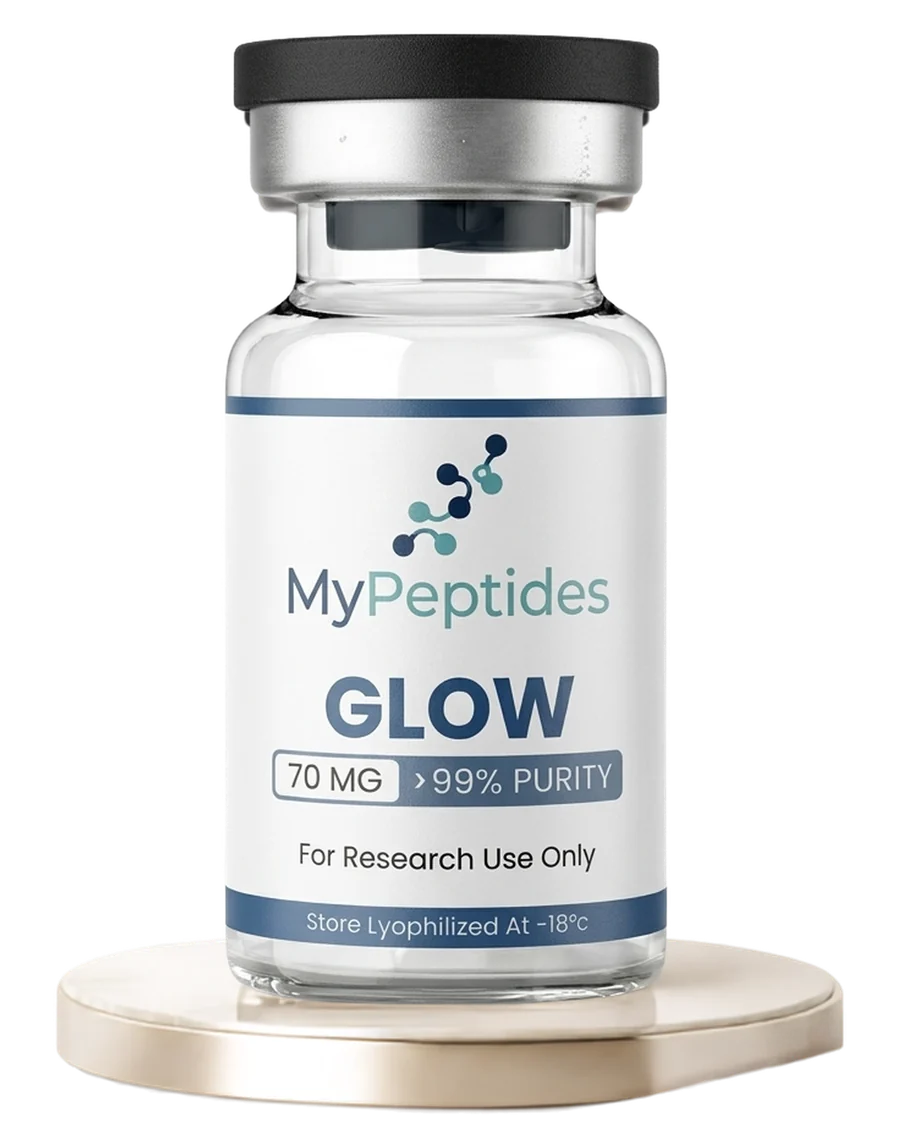
GLOW 70 mg research peptide vial, >99% purity

Skin & Aesthetics · Dermal Radiance

The Ultra-Potency Regenerator

GLOW

  • 70 mg
  • >99% purity
  • Lyophilised

RM 500

Reverse the fade. This 70mg master blend is the ultimate cellular reset, restoring your natural radiance from the cell up.

Key mechanisms & benefits

  • It powerfully stimulates collagen and elastin, thickening your skin’s foundation for a visibly lifted, sculpted canvas.
  • By accelerating deep tissue renewal, it smooths texture, fades environmental damage, and delivers a brilliantly even finish.
  • Reclaim your sovereign glow and step into every room with effortless, ageless confidence.
Certificate of Analysis

All products are independently tested by accredited third-party laboratories. Results confirm identity, purity, and potency.

In stock

1
  • No online payment. We confirm your order on WhatsApp.
  • Store lyophilised at −18 °C.
Ask about this product

For research use only. Not for human or veterinary consumption. This product is not a medicine and is not intended to diagnose, treat, cure or prevent any disease.

Overview

GHK-Cu, BPC-157 and TB-500: A Three-Peptide Skin and Repair Blend

GLOW is a 70 mg research blend of three peptides: GHK-Cu (50 mg), BPC-157 (10 mg) and TB-500 (10 mg). It combines the copper peptide GHK-Cu, studied for collagen and skin remodelling, with two repair peptides studied for angiogenesis, cell migration and tendon healing.

Each component has its own research literature, mostly preclinical. The blend is designed for research into skin and soft-tissue repair where matrix remodelling, blood supply and cell migration are all involved. The combination itself has not been studied in clinical trials.

Mechanism of action

GHK-Cu

Collagen and Remodelling

The copper peptide that makes up most of the blend

  • Stimulated fibroblast collagen synthesis from 10⁻¹² M
  • Regulates both synthesis and breakdown of matrix
  • Increases elastin and glycosaminoglycans
  • Naturally present in human plasma, declining with age
  • Maquart FX et al., 1988; Pickart L et al., 2015
BPC-157

Blood Supply

Pro-angiogenic signalling through VEGFR2

  • Up-regulates VEGFR2 in endothelial cells
  • Activates the VEGFR2-Akt-eNOS pathway
  • Increases vessel density in vivo and in vitro
  • Supports tendon fibroblast migration and survival
  • Hsieh MJ et al., J Mol Med, 2017
TB-500

Cell Migration

The actin-binding fragment of thymosin β4

  • Ac-LKKTETQ is Tβ4's central actin-binding site
  • This region promotes cell migration and wound healing
  • Full-length Tβ4 increased re-epithelialisation 42% at day 4 in rats
  • Tβ4 stimulated keratinocyte migration 2–3-fold
  • Sosne G et al., 2010; Malinda KM et al., 1999

Key finding GLOW brings together three separately studied mechanisms: GHK-Cu's potent collagen stimulation in fibroblasts, BPC-157's VEGFR2-driven angiogenesis, and the cell-migration and wound-healing activity of thymosin β4's actin-binding region.

Key research findings

10⁻⁹ M

GHK-Cu stimulated fibroblast collagen synthesis, peaking at 10⁻⁹ M

Maquart FX et al. FEBS Lett, 1988
VEGFR2

BPC-157 up-regulated VEGFR2 and increased vessel density

Hsieh MJ et al. J Mol Med, 2017
+42%

Full-length thymosin β4 increased re-epithelialisation at day 4 in rat wounds, and up to 61% at day 7

Malinda KM et al. J Invest Dermatol, 1999
Skin

GHK accelerates wound healing of skin, hair follicles and other tissues in several species

Pickart L et al. Biomed Res Int, 2015

Research areas

Skin Remodelling Research

Collagen, elastin and matrix turnover.

  • Fibroblast collagen studies
  • Elastin and glycosaminoglycans
  • Photoaging models
  • Matrix turnover

Wound Healing Research

Re-epithelialisation, angiogenesis and cell migration in one preparation.

  • Full-thickness wound models
  • Keratinocyte migration
  • Angiogenesis
  • Collagen deposition

Soft-Tissue Repair Research

BPC-157 and TB-500 both have tendon repair data in rats.

  • Tendon repair models
  • Fibroblast migration
  • Biomechanical recovery
  • Collagen organisation

Blend Research

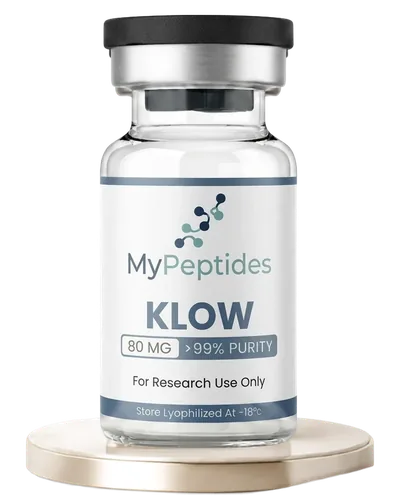
Comparing the blend with its components, and with KLOW (which adds KPV).

  • Component comparison designs
  • GLOW vs KLOW studies
  • Single-vial protocols
  • Formulation stability

Safety profile

Each component has preclinical safety literature, but the three-peptide combination has not been studied in humans. GLOW is supplied for laboratory research only.

  • Caution
    Pro-angiogenic

    BPC-157 and the thymosin β4 region promote angiogenesis; account for this in oncology research designs

  • Low
    Copper content

    GHK-Cu contributes copper; consider copper metabolism endpoints

  • Low
    WADA prohibition

    BPC-157 and TB-500 are on the World Anti-Doping Agency prohibited list

Components
GHK-Cu 50 mg, BPC-157 10 mg, TB-500 10 mg
Human data
Not established for the blend
Regulatory status
Research use only

Theoretical contraindications in research models

  • Active malignancy: pro-angiogenic components
  • Wilson disease or copper metabolism disorders
  • Any human or veterinary use: research compound only

Molecular profile

Blend Profile

Format
Lyophilised three-peptide blend
Total
70 mg per vial
Purity
>99% all components

Components

GHK-Cu
Gly-His-Lys · Cu²⁺, 340.4 Da, CAS 49557-75-7
BPC-157
15 amino acids, 1,419 Da, CAS 137525-51-0
TB-500
Ac-LKKTETQ, 7 amino acids, ≈ 889 Da

MYpeptides specification

Strength
70 mg
Composition
GHK-Cu 50 mg + BPC-157 10 mg + TB-500 10 mg
Purity
> 99%
Form
Lyophilised powder
Storage
Store lyophilised at −18 °C
Status
For research use only

Frequently asked questions

What is in GLOW?

Three peptides in one 70 mg vial: GHK-Cu 50 mg, BPC-157 10 mg and TB-500 10 mg.

What is the difference between GLOW and KLOW?

KLOW contains the same three peptides plus KPV, an anti-inflammatory tripeptide from α-MSH. GLOW is the three-peptide version without KPV.

Has the GLOW blend been studied in humans?

No. Each component has its own research literature, mostly preclinical, but the combination has not been studied in clinical trials. It is supplied for laboratory research only.

How should GLOW be stored?

Lyophilised vials should be stored frozen at −18 °C or below, away from light. Once reconstituted for laboratory use, keep refrigerated at 2–8 °C.

References

  1. Stimulation of collagen synthesis in fibroblast cultures by the tripeptide-copper complex glycyl-L-histidyl-L-lysine-Cu2+Maquart FX et al. FEBS Lett, 1988 · PMID: 3169264
  2. GHK Peptide as a Natural Modulator of Multiple Cellular Pathways in Skin RegenerationPickart L et al. Biomed Res Int, 2015 · PMID: 26236730
  3. Therapeutic potential of pro-angiogenic BPC157 is associated with VEGFR2 activation and up-regulationHsieh MJ et al. J Mol Med, 2017 · PMID: 27847966
  4. Thymosin beta4 accelerates wound healingMalinda KM et al. J Invest Dermatol, 1999 · PMID: 10469335
  5. Biological activities of thymosin beta4 defined by active sites in short peptide sequencesSosne G et al. FASEB J, 2010 · PMID: 20179146
R3 20 mg research peptide vialMetabolic

The Triple Agonist

R3

20 mg · >99% purity

In stock

RM 650